^^data flywheel
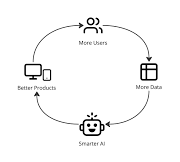
prompt: data flywheel (meaning)
A data flywheel is a self-reinforcing, virtuous loop where user interactions
generate data, which is then used to refine and improve AI or product models. As
the product improves, it attracts more users, which generates even more data to
accelerate the cycle, ultimately delivering better outcomes and lowering
operational costs.
Understanding the flywheel involves breaking it down into its core
components:
- User Interaction: Consumers or systems use an AI agent or digital
product, generating real-world data and feedback logs.
- Data Curation: The system filters and organizes the most valuable
interaction data to identify usage patterns.
- Model Customization: This refined data is fed back into the
underlying AI models through fine-tuning or training.
- Continuous Improvement: The upgraded model yields more accurate
outputs, increased user satisfaction, and better engagement.I
n the artificial intelligence sector, data flywheels are highly prized for
reducing inference costs and compute requirements. Organizations continuously
evaluate production data against smaller, more cost-effective models without
having to constantly retrain systems from scratch.
Leading frameworks and blueprints in this space include:
- NVIDIA: Utilizes the NVIDIA NeMo Blueprint and tools like the
NVIDIA NeMo Customizer and Evaluator to streamline and optimize AI agent
interactions with real traffic.
- Industry Frameworks: Platforms like Snowplow Data Flywheel Guide
and AWS Data Flywheel offer methodologies for applying these loops across
various cloud and ML architectures.
If you want, let me know:
- Is your primary interest in Generative AI models or general
business/growth loops?
- Are you building an AI application and need help figuring out what to
track?
I can tailor the next steps to your specific situation